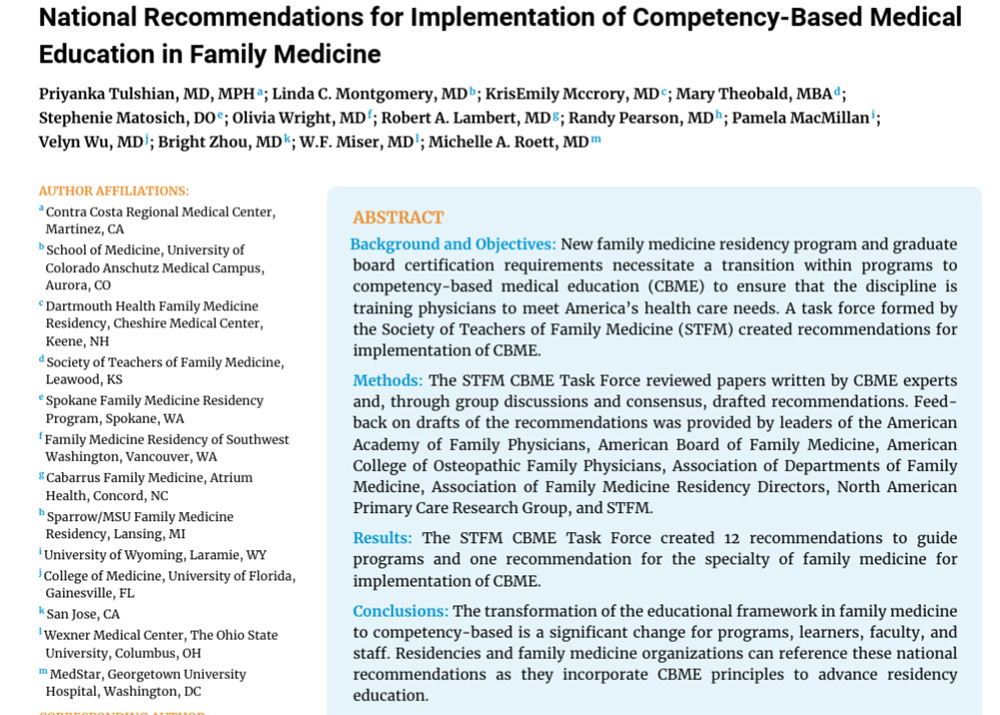
As family medicine residency programs transition toward a Competency-Based Medical Education (CBME) framework, many find themselves at different stages of readiness. To move from theory to practice, programs must identify their current position, recognize barriers, and set actionable goals.ACGME family medicine program requirements and ABFM board certification requirements necessitate a transition within programs to competency-based medical education (CBME) to ensure that the discipline is training physicians to meet the United States' health care needs. A task force formed by STFM created recommendations for implementation of CBME.The STFM CBME Task Force reviewed papers written by CBME experts and, through group discussions and consensus, drafted recommendations. Feedback on drafts of the recommendations was provided by leaders of the American Academy of Family Physicians, American Board of Family Medicine, American College of Osteopathic Family Physicians, Association of Departments of Family Medicine, Association of Family Medicine Residency Directors, North American Primary Care Research Group, and STFM.
Bring CBME to Your Family Medicine Residency Program
Use this page for practical strategies, examples, and tools to help your family medicine residency program implement competency-based medical education in daily teaching, assessment, and program operations.
Implementation Framework
To ensure a successful and collaborative transition, follow these strategic steps:
- Assemble a Core Team: This process is most effective when conducted by a diverse group of faculty members and stakeholders responsible for the CBME curriculum.
- Identify Your Stage: Use the Implementation Road Map to pinpoint exactly where your program sits within each "pillar" of the CBME framework.
- Assess and Define: Have each team member complete the Needs Assessment and Planning Tool. Use these insights to develop SMARTIE Objectives (Strategic, Measurable, Ambitious, Realistic, Time-bound, Inclusive, and Equitable) for each pillar.
- Build Consensus: Create dedicated forums for discussion. Share individual assessments to establish a unified vision and a shared set of program-wide SMARTIE goals.
- Establish a Cycle of Improvement: CBME implementation is an iterative process. Create a formal system to review the program’s progress annually using the Road Map and Needs Assessment tools as benchmarks.
National Recommendations for Implementation
The STFM CBME Task Force created 12 recommendations to guide programs and one recommendation for the specialty of family medicine for implementation of CBME.
Recommendations for Programs
Thirteen recommendations, guided by the best available evidence, task force expertise, group consensus, and input from leaders of family medicine organizations were compiled to guide transition to CBME in family medicine residency programs.
- Programs should create learning environments that support residents in the development of the characteristics of a master adaptive learner (MAL) with the use of individualized coaching, reflection, and faculty development.
- Programs should provide residency administrators/coordinators adequate time and training to implement and manage tracking systems for competency-based medical education assessment.
- Programs should engage residents in tailoring elective time to meet individual educational goals and to progress toward competence in the family medicine core outcomes.
- Programs should foster a culture of reflective feedback conversations.
- Resident assessment should occur frequently throughout the continuum of care using multiple modalities, with most assessments being grounded in direct observation.
- Throughout training, a five-level entrustment framework should be used to assess residents on their progression toward entrustability.
- Programs should provide residents updates on their progress toward achieving the family medicine core outcomes based on holistic resident review done by the Clinical Competency Committee at least every 6 months.
- Programs should provide dedicated time for structured ongoing faculty development in the implementation of CBME.
- Programs should engage faculty and residents to create an assessment system that minimizes the assessment burden on faculty and residents.
- Programs should provide faculty development in coaching skills to engage residents in self-regulated learning
- Individualized learning plans should be created with all residents during the first 6 months of residency and updated quarterly throughout training, with interval coaching/advising to facilitate growth.
- Individualized learning plans should include specific , measurable , attainable, relevant, time-bound, inclusive, and equitable (SMART-IE) objectives that are aligned with the family medicine core outcomes.
Recommendation for the Specialty
- Relevant stakeholders in family medicine graduate medical education should collaborate to develop and implement a mobile application to streamline the ability of faculty to provide real-time feedback and assessment of residents.