CONFERENCES

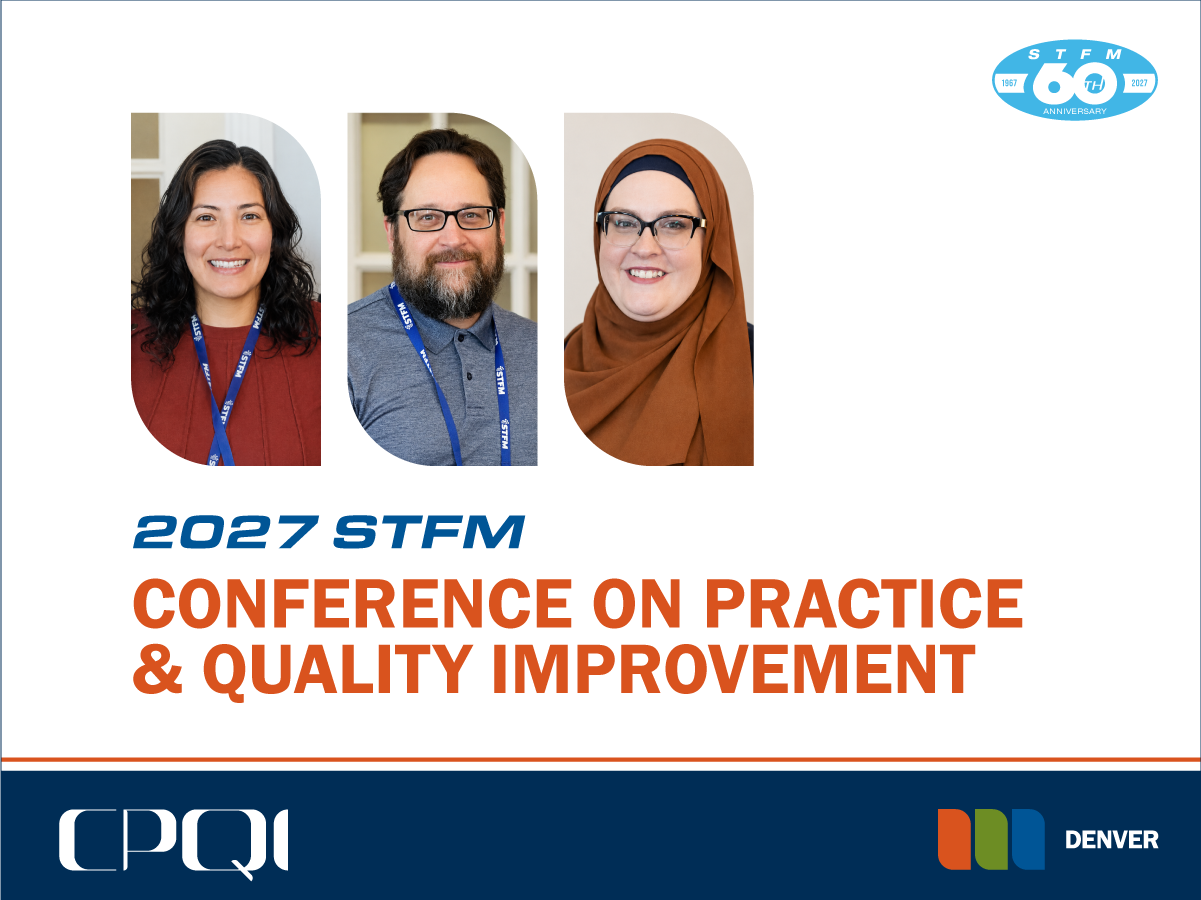
2026 STFM Conference on Practice & Quality Improvement

Come be on the leading edge of evolving health care at the STFM Conference on Practice & Quality Improvement. Join other health care professionals invested in transforming their medical practice or residency program to benefit patients. Registration is now OPEN for the 2026 STFM Conference on Practice & Quality Improvement: August 31–September 2, 2026, in Palm Desert, CA. Register now for $100 off the usual price.

SEE EARLY-BIRD REGISTRATION PRICES REGISTER ONLINE

Why You Should Attend the STFM Conference on Practice & Quality Improvement

Enhance Patient Care Through Proven Strategies

Attendees gain access to the latest evidence-based tools, workflows, and models that directly improve patient outcomes in family medicine practices.

Learn From Leaders in Academic and Clinical Practice

The conference features expert presenters from across the United States, who share real-world experiences, research, and innovative quality improvement initiatives.

Stay Current With Evolving Healthcare Trends

Sessions cover timely topics such as value-based care, team-based approaches, health equity, social determinants of health, and patient engagement strategies.

Boost Teaching and Mentorship Skills

Ideal for academic clinicians and educators, the conference offers insights into integrating quality improvement into residency programs, medical student training, and faculty development.

Support and Strengthen the Future of Family Medicine

Connect with peers, mentors, and collaborators from across the country who are working on similar QI goals. These relationships can spark future projects, research, or institutional change.

Take Home Actionable Solutions

Whether you’re in a community-based practice or a large academic health system, the conference provides practical takeaways, tools, and templates that can be implemented immediately.

Registration Information

Registration for the 2026 STFM Conference on Practice & Quality Improvement is now open. Visit the registration page for more information. The conference will be at the JW Marriott Desert Springs Resort & Spa in Palm Desert, CA. Visit our hotel and travel page to reserve your room at our host hotel.

More Details About the STFM Conference on Practice & Quality Improvement

Equip yourself with the tools, insights, and strategies to transform your medical practice or residency program. Dive into the art of cultivating interprofessional teams that enhance productivity and elevate patient care. Connect with a diverse array of professionals, all united in their dedication to perpetual practice enhancement and groundbreaking innovation.In 2024, STFM incorporated crucial components of the Forum for Behavioral Science in Family Medicine into the STFM Conference on Practice & Quality Improvement. The conference now provides specific content on behavioral science and integrated health. While the primary emphasis of the conference will continue to be on overall practice and quality improvement, we hope to involve even more colleagues from the behavioral science field to enrich our content and foster enhanced interprofessional interactions.

Featured General Sessions

31
Aug
OPENING SESSION

Sachin H. Jain, MD, MBA

SCAN Group and SCAN Health Plan

"Fireside Chat with Dr Sachin Jain"

Join us for a fireside chat with Sachin H. Jain, MD, MBA, as he explores the intersection of leadership, equity, and innovation in healthcare delivery. This session will examine how healthcare organizations can address disparities in access, quality, and outcomes while advancing patient-centered, community-responsive care.

LEARN MORE ABOUT THE SESSION
1
Sep
GENERAL SESSION

Amelia Sattler, MD

Stanford University

"Aims Before Algorithms: A Problem-Driven Approach to AI"

Artificial intelligence (AI) is transforming clinical care, medical education, and research. While AI has significant potential, meaningful integration remains challenging. When AI-powered tools are developed in technology silos without close collaboration with key stakeholders, real-world impact is limited. Even the most powerful AI tools lack practical value if they aren’t conceptualized, designed and integrated to address clearly defined and meaningful problems. These challenges highlight the need for a problem-driven approach to AI development and adoption. This session will present a practical framework for advancing AI initiatives grounded in quality improvement principles.

LEARN MORE ABOUT THE SESSION
2
Sep
GENERAL SESSION

Gary LeRoy, MD

American Board of Family Medicine

"The Art of Noticing Unnoticed Wisdom: Why This, Why Now, Why Me (Us)?"

This presentation reflects on the evolving purpose, responsibility, and resilience of family physicians in a rapidly changing healthcare environment. Drawing from three decades of leadership, teaching, and historical keynote addresses, the speaker invites attendees to reconsider how physicians grow professionally while remaining grounded in the relational and moral foundations of medicine. By contrasting the non-binary curiosity and joy of childhood development with the rigid, outcome-driven mindset common in adult professional life, the presentation reframes burnout as a loss of meaning rather than a lack of effort or reward.

LEARN MORE ABOUT THE SESSION

Questions?

If you have questions about this conference, contact Kim Sevedge at (800) 274-7928 or the email link below.

CONTACT STAFF WITH QUESTIONS

Ask a Question
AI Chatbot Tips

Tips for Using STFM's AI Assistant

STFM's AI Assistant is designed to help you find information and answers about Family Medicine education. While it's a powerful tool, getting the best results depends on how you phrase your questions. Here's how to make the most of your interactions:

1. Avoid Ambiguous Language

Be Clear and Specific: Use precise terms and avoid vague words like "it" or "that" without clear references.

Example:

Instead of: "Can you help me with that?"
Try: "Can you help me update our Family Medicine clerkship curriculum?"
Why this is important: Ambiguous language can confuse the AI, leading to irrelevant or unclear responses. Clear references help the chatbot understand exactly what you're asking.

2. Use Specific Terms

Identify the Subject Clearly: Clearly state the subject or area you need information about.

Example:

Instead of: "What resources does STFM provide?"
Try: "I'm a new program coordinator for a Family Medicine clerkship. What STFM resources are available to help me design or update clerkship curricula?"
Why this is better: Providing details about your role ("program coordinator") and your goal ("design or update clerkship curricula") gives the chatbot enough context to offer more targeted information.

3. Don't Assume the AI Knows Everything

Provide Necessary Details:The STFM AI Assistant has been trained on STFM's business and resources. The AI can only use the information you provide or that it has been trained on.

Example:

Instead of: "How can I improve my program?"
Try: "As a program coordinator for a Family Medicine clerkship, what resources does STFM provide to help me improve student engagement and learning outcomes?"
Why this is important: Including relevant details helps the AI understand your specific situation, leading to more accurate and useful responses.

4. Reset if You Change Topics

Clear Chat History When Switching Topics:

If you move to a completely new topic and the chatbot doesn't recognize the change, click the Clear Chat History button and restate your question.
Note: Clearing your chat history removes all previous context from the chatbot's memory.
Why this is important: Resetting ensures the AI does not carry over irrelevant information, which could lead to confusion or inaccurate answers.

5. Provide Enough Context

Include Background Information: The more context you provide, the better the chatbot can understand and respond to your question.

Example:

Instead of: "What are the best practices?"
Try: "In the context of Family Medicine education, what are the best practices for integrating clinical simulations into the curriculum?"
Why this is important: Specific goals, constraints, or preferences allow the AI to tailor its responses to your unique needs.

6. Ask One Question at a Time

Break Down Complex Queries: If you have multiple questions, ask them separately.

Example:

Instead of: "What are the requirements for faculty development, how do I register for conferences, and what grants are available?"
Try: Start with "What are the faculty development requirements for Family Medicine educators?" Then follow up with your other questions after receiving the response.
Why this is important: This approach ensures each question gets full attention and a complete answer.

Examples of Good vs. Bad Prompts

Bad Prompt

"What type of membership is best for me?"

Why it's bad: The AI Chat Assistant has no information about your background or needs.

Good Prompt

"I'm the chair of the Department of Family Medicine at a major university, and I plan to retire next year. I'd like to stay involved with Family Medicine education. What type of membership is best for me?"

Why it's good: The AI Chat Assistant knows your role, your future plans, and your interest in staying involved, enabling it to provide more relevant advice.

Double Check Important Information

While the AI Chat Assistant is a helpful tool, it can still produce inaccurate or incomplete responses. Always verify critical information with reliable sources or colleagues before taking action.

Technical Limitations

The Chat Assistant:

  • Cannot access external websites or open links
  • Cannot process or view images
  • Cannot make changes to STFM systems or process transactions
  • Cannot access real-time information (like your STFM Member Profile information)

STFM AI Assistant
Disclaimer: The STFM Assistant can make mistakes. Check important information.