The Call for Proposals for the 2027 STFM Conference on Medical Student Education is currently CLOSED.The Call for Proposals for the 2027 conference will open in the spring of 2026.
Session Formats
Completed Research Project
Purpose: To present completed research, education, process of care, patient-oriented outcomes, and quality of care studies, including assessment. All content and methods will be considered. Please do not submit work that has been published prior to submission deadlines.
Time: 15 minutes (10-minute presentation with 5 minutes of Q&A. Four 15-minute presentations are "grouped" by common topic and presented consecutively in a 60-minute presentation time slot.)
In-Progress Research Project
Purpose: To present innovative or pilot projects in progress related to teaching, education, curricular or clinical intervention, management innovation, or quality improvement that do not have outcomes or assessments.
Time: 15 minutes (10-minute presentation with 5 minutes Q&A. Four 15-minute presentations are "grouped" by common topic and presented consecutively in a 60-minute presentation time slot.)
Lecture Discussion
Purpose: A forum for concise didactic presentation followed by discussion. The focus may be clinical, research, administrative, educational, or personal or career development. Purely clinical topics, addressed in a scholarly way, are also appropriate.
Time: 30 minutes (20-minute presentation, 10 minutes of discussion/response)
Panel Discussion
Purpose: A moderated, interactive session that brings together 3–5 panelists to engage participants in discussion about an innovative or provocative topic in family medicine education. The panelists must demonstrate their content expertise in the submission and ideally, represent multiple institutions. There are limited slots for this session format.
Time: 60 minutes
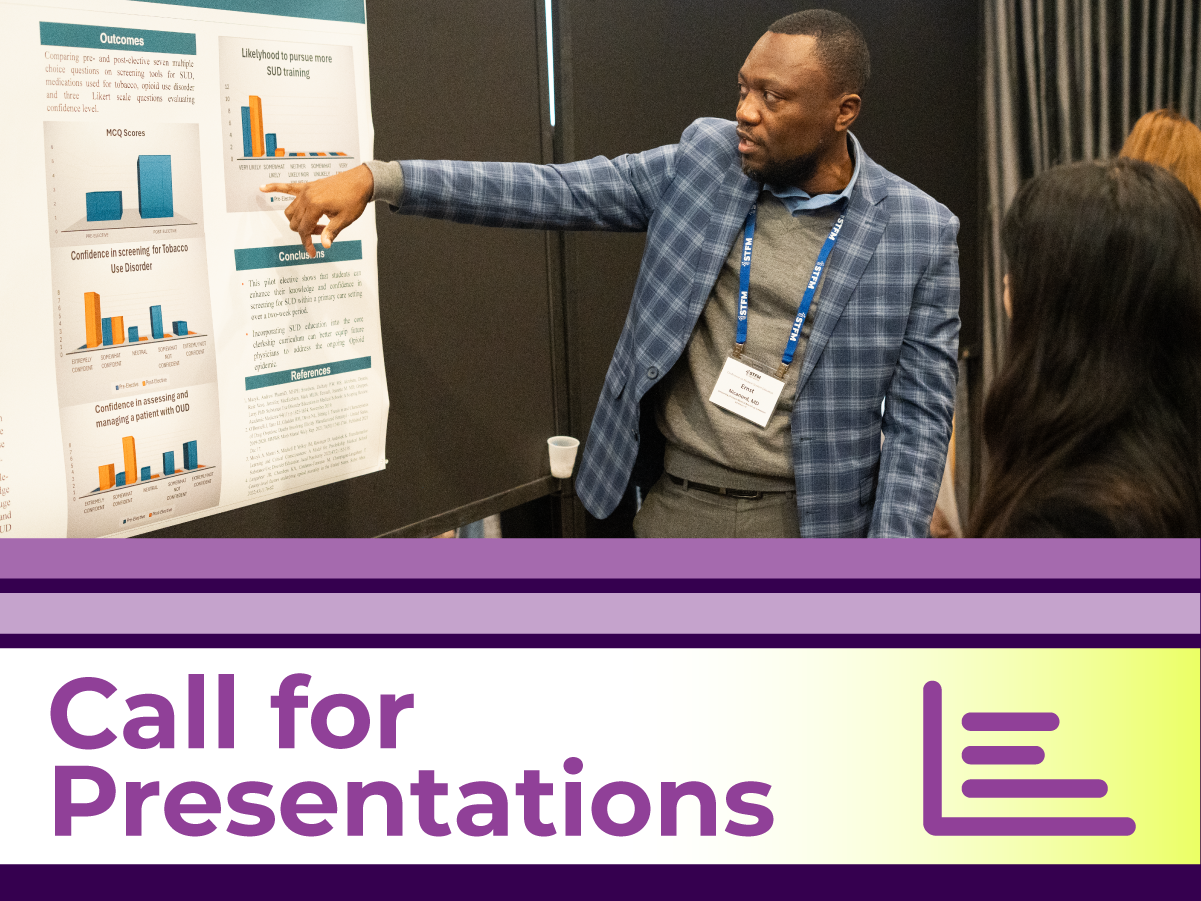
Poster
Purpose: To provide an opportunity to display quality-of-care studies and discuss investigator's completed original research; or, discuss an innovative educational or curricular project pertinent to family medicine.
Time: 1 hour staffing your poster during dedicated time
Preconference Workshop
Purpose: To present high-quality, interactive sessions that require more time than the regular conference format allows. Space is very limited. STFM will charge a registration fee to help cover the costs of materials, audio/visual equipment, room rental, administration, and refreshments.
Time: 4 hours
Scholarly Topic Roundtable Discussions
Purpose: To provide an opportunity for a roundtable discussion for 10 participants about ideas, experiences, or projects pertinent to family medicine education, clinical care, research, or management. This presentation is scheduled concurrently with other presentations during continental breakfast in the general session ballroom.
Note: Audio-visual equipment is not provided for this presentation. Handout materials are encouraged.
Time: 60 minutes
Seminar
Purpose: To provide an interactive session about an innovative educational, administrative, research, career development, or clinical topic. Active audience participation beyond question and answer is required.
Time: 60 minutes
Workshop
Purpose: To provide a task-oriented, small-group educational experience directed toward the acquisition, demonstration, construction, and/or synthesis of specific knowledge, skills, and/or attitudes.
Note: This is a highly competitive submission category. The conference steering committee only accepts a small number of workshops for presentation.
Time: 90 minutes
Questions?
For questions about submitting presentation proposals, contact staff at (800) 274-7928 or the email link below.
CONTACT STAFF WITH QUESTIONS